

How is a bridge built? A look behind the scenes of tramway bridge construction
Three bridges along the Pirkkala–Linnainmaa tramway route are currently being renewed. For most of us, bridges are just an ordinary part of everyday travel, and we rarely stop to think about how much work goes into building them. This article explains, how a bridge develops from the first plans to a completed structure.

It all starts with planning
Before a bridge can be built, it must first be carefully designed and coordinated with all other technical disciplines involved in constructing the tramway. Bridge planning takes into account factors such as soil bearing capacity, the types of traffic the bridge will carry, and the surroundings where the bridge will be located.
Within the Pirkkala–Linnainmaa alliance of Tampere Tramway, designers and builders work closely together. The bridge specialists involved – known as special structure builders – participate from the very early stages of the project, contributing a production-oriented perspective to the planning process.
For Veetu Helkiö, who serves as the worksite manager for special structures in the Pirkkala–Linnainmaa alliance, bridge construction is familiar work from earlier phases of the Tampere Tramway project. Now he outlines the key stages involved in building a bridge.

Bridges are rebuilt one side at a time
The bridges along the tramway route are renewed in two phases. First, the old bridges are demolished, and after that can construction of the new ones begin. In addition to the tramway, each bridge will have its own routes for car traffic, as well as for walking and cycling.
“All three bridges are located in busy traffic areas on Hatanpään valtatie and Nuolialantie, so traffic must keep moving even during construction. That’s why we rebuild the bridges in two stages: when one side of a bridge is under renovation, the other side remains open for normal use,” Helkiö explains.

Construction progresses from foundations to surface structures
Building a new bridge starts with the foundations. If the soil is soft or has poor bearing capacity, the bridge site must first be reinforced.
“We strengthen the ground using driven or drilled piles. In practice, this means installing long piles deep into the ground to support the bridge structure. The piles are driven or drilled down to a solid soil layer or bedrock. The type of piling is chosen based on the ground conditions and the type of bridge being built. The heavier the loads the bridge will carry, the stronger the piles need to be,” Helkiö says.

When the ground is properly reinforced, construction can move on to the bridge’s substructures: the foundations and the abutments and intermediate supports. Smaller bridges do not always require separate support columns – piles alone may be enough to carry the bridge. For example, on the Vihilahti and Härmälänoja bridges, the piles connect directly to the bridge deck, whereas the Viinikanlahti bridge requires its own support pillars.
“For bridges that cross waterways, a working platform, known as falsework, is needed so that construction can be done safely above the water. Once the falsework is in place, we can move on to building the bridge deck,” Helkiö continues.

The construction of the bridge deck begins with erecting scaffolding and formwork, into which the reinforcement is installed and, finally, the concrete is poured. Deck castings are one of the most impressive phases of the project, and once they are completed, the final shape of the bridge starts to become visible. After the concrete has cured, the scaffolding and formwork can be removed. Finally, the deck is finished with tasks such as protective concrete layers, waterproofing, and the installation of railings.
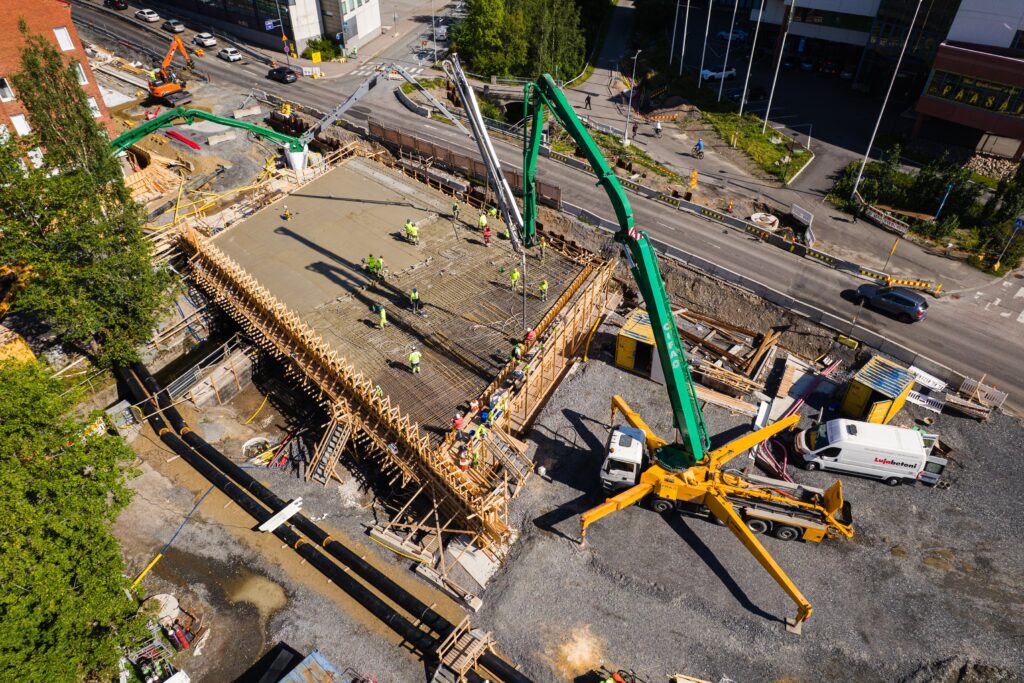
The last phase involves the surface structures – everything that is built on top of the bridge deck. On the Viinikanlahti, Vihilahti and Härmälänoja bridges, the roadway and the walking and cycling paths are finished with asphalt. The tramway’s surface structure, however, varies: the Vihilahti bridge will have a grass track, the Viinikanlahti bridge will feature concrete paving stones, and the Härmälänoja bridge will have an asphalt surface.
The bridges are completed in stages
Construction of all three bridges began in 2025, but the work is progressing at slightly different paces. The Härmälänoja bridge is the furthest along: the first bridge was completed last autumn, and work has already started on the formwork for the second deck. At Viinikanlahti, the first half of the bridge has also been completed, and piling work for the second half has begun. On the Vihilahti bridge, reinforcement of the first deck is currently underway.
The Härmälänoja and Viinikanlahti bridges, as well as the first half of the Vihilahti bridge, will be completed already next summer. The entire set of bridges will be finished in 2027, when the second half of the Vihilahti bridge is also completed. Once ready, the bridges will serve users well into the future and improve mobility along the tramway route.
“The best part of building bridges is knowing that your work leaves a concrete, long-lasting mark on the city,” Helkiö sums up.
